HEADLINES

Showing posts with label Zeitgeist. Show all posts

Tuesday, April 24, 2007

DECIVILISATION

David Cameron yesterday called for a challenge to the increasing acceptance of anti-social behaviour as the norm.

"We all have experience of road rage, Tube rage, never mind what is said if you ask someone not to drop litter or cycle on the pavement," Mr Cameron told the Royal Society of Arts in London. "All these are sad signs of a culture that is becoming de-civilised."

He should be applauded for talking about a subject which, on a day-to-day level, concerns people perhaps more than any other. The cultural and lesiure worlds are also far from immune from increasingly selfish public behaviour - to the extent that many are increasingly taking the option to 'go private', stay at home and avoid the public arena altogether.

Here's a piece which NCF director Peter Whittle wrote for The Spectator back in 2005 on this particular aspect of a hugely important issue:


SLURPS, BURPS AND BLEEPS

Peter Whittle on the misery of being surrounded by slobs in theatres and cinemas.


A few weeks ago I left a performance of Vera Drake emotionally drained. As the lights came up I felt a mixture of indignation, suppressed anger and loathing for the injustices human beings inflict on each other. It took a couple of stiff glasses to settle me down.

Unfortunately it wasn't the abortion theme in Mike Leigh's drama which had brought this on, or Imelda Staunton's quivering performance. It was rather that I had just endured two hours of sitting next to a slob who'd loudly munched his way through two bags of popcorn. With legs sprawled and eyes fixed emotionlessly on the screen, he could have been channel surfing in a hotel room. His hand went robotically from bag to mouth, the motion unaffected by any of the movie's highs or lows. Caught in the corner of my eye, this monotonous action was like an irritating eyelash obscuring my vision. Discrete attempts at registering disapproval – subtle coughs and sideways glances - failed to have the desired impact. He was utterly, noisily oblivious to my discomfort, and he ruined the film for me.

As anti-social behaviour goes, this was hardly Asbo material. But then neither is queue jumping, or the use of train seats as foot rests. They're widespread habits which fly well under the radar of arrestable offence but which in their ugliness impoverish everyday life. And, whether it is brain-dead grazing and incessant chattering in cinemas, or the ringing of mobile phones and group coughing in theatres, or mindless American-style whooping at the end of a ballet, the cultural world is not immune. 'You should get out more' might be one of today's mantras, but maybe the cool option really is to stay in with your books, CDs and DVDs. Either that, or risk feeling genuinely homicidal by the end of what should have been an uplifting, thought-provoking or even just mildly diverting evening out.

Last year Kevin Spacey, just installed as artistic director of the Old Vic, railed against the ever-growing chorus of sweet sucking and ring tones during theatre performances. 'My feeling is if people don't know how to behave, they shouldn't come,' he declared courageously. He'd already shown the strength of his feeling on this by snapping 'Tell them we're busy!' when a phone went off while he was on stage during The Iceman Cometh. Similarly the actor Richard Griffiths went so far as to stop a recent performance of The History Boys at the National Theatre, exasperated by the persistent beeping of a pager. 'I'm sorry, but I can't compete with your electronic device,' he declared to the mortification of the culprit, receiving an enthusiastic round of applause from the rest of the house.

Of course when actors speak up they risk being mocked as typically precious luvvies. And some theatre people, aware of charges of elitism and endlessly straining to appear modishly accessible, play down disruptive behaviour. It was ever thus, they say, and quote the tired old comparisons with the unruliness of Shakespearean audiences. Or they see it as the theatre's responsibility. David Lan, artistic director of the Young Vic, asserts that if people aren't paying attention, the theatre isn't doing its job. 'You cannot blame an audience if it isn't engaged with what you're doing,' he says.

Well, up to a point. But what if large sections of the audience are indeed engaged but are having their enjoyment of a play or film sabotaged by the growing yob tendency, those people from all parts of the social spectrum who do what they want, when they want, and bugger the rest? It can make one feel murderous. Watching The Nutcracker at the ENO at Christmas, we had a family in front of us who, attention span presumably stretched to breaking point, had obviously grown restless. They fidgeted, chatted, and sat dangling their trainer-clad feet over the empty row in front of them. As the mother dozed, the two teenage daughters got up and wandered about from seat to seat, indifferent to both what was happening on stage and the obvious irritation of those of us square enough to be sitting quietly.

For many, the experience of live performance is probably to be approached in the same solipsistic way as watching a DVD at home. So they dress appropriately too. You really don't have to be a reactionary old fogy to find demoralising the sight of ropey tracksuit bottoms amid splendid architecture built to celebrate the highs of the artistic spirit. Such torpid lack of effort goes along with inconsiderate behaviour; it suggests at the very least no sense of occasion, at the worst a general cultural enervation. What's the big deal?

No, in the narcissistic spirit of our age, it's all about letting others be damned. Even in expressing your appreciation of a performance, you have to be saying something about yourself. Those who've shown every sign of utter boredom (such as sleeping), rally themselves enough to whoop like demented hyenas on a TV game show when the curtain comes down. This imported practise makes the self-centred feel part of the artistic process – you've had your moment, they're saying, now I'll have mine. 'Is it another mark of the Me generation?' wrote Arlene Croce in the New Yorker when it was first heard on the American scene years ago. 'All the traditional audience vocables – Bravos, oles - say You were wonderful; they're directed to the performer. These wordless woofs say, I'm wiped out.'

Perhaps old-fashioned clapping is just too, well, altruistic. But what about making equally quaint requests of others to desist from talking, playing with sweet wrappings or dumping partners by mobile? This can be hazardous; much of our interaction with strangers now carries a bat squeak of underlying violence, and the friends I canvassed for their cinema experiences said roughly the same thing: it's not worth the aggro. Civil codes have been up-ended to the extent that now you're considered the rude one for protesting, however gently you do it. You wait, shoulders taut, for the stream of foul-mouthed abuse, or the kick in the back of the chair. It's easier to move, and let them win.

In the theatre however, you're stuck in the same seat. Jonathan, a TV producer friend, witnessed an incident at a West End matinee which resulted in the police being called. "Two teenagers had been making so much noise during the performance that a middle-aged lady had to turn round and ask them to be quiet, a heroic act in the minds of most of us,' he says. 'For this, she was rewarded with a slap across the back of the head and all sorts of unpleasant threats for the rest of the play. From the point of view of these kids, some stupid middle-aged stiff had shown them a colossal disrespect by daring to ask them to be quiet.'

An extreme example perhaps, and on the general scale of social breakdown, bad audience behaviour remains low priority. It's not going to make Panorama. But ignored it becomes just another little incentive for us to abandon the public arena in favour of an increasingly private existence. We could follow the lead of the French, who have recently installed phone signal blocking in their cinemas, theatres and concert halls; if we can't rely on personal restraint, then maybe Nanny will have to intervene. In the meantime, there's nothing for it but to continue suffering in silence - albeit one punctuated by slurps, burps and bleeps.

Tuesday, April 03, 2007

Culture Clash tonight at 8.30pm on 18 Doughty Street Talk TV

Last week on Channel 4’s Dispatches programme, journalist and Mail on Sunday columnist Peter Hitchens ripped into David Cameron, claiming that his leadership of the Conservatives spelt the end of parliamentary politics as we have known it, and that as a politician he was not only not a real conservative, but was without conviction of any kind.

However much of the programme was given over to an examination of Cameron’s upper class background, and the attempts he’s made, in Hitchens eyes, to cover it up. Tonight, we’ll be discussing quite what Hitchens was trying to get at, and more broadly, the part which class plays, if any at all, in our society today.

My guests tonight are Anthony Browne, chief political correspondent of The Times, author and columnist James Delingpole, Susan Shaw senior producer of The South Bank Show, and Dominic Hilton of the New Culture Forum.

Wednesday, March 14, 2007

Culture Clash on 18 Doughty Street Talk TV


This week – everything you always wanted to ask about being conservative, but were too afraid to ask. We’ll be looking at the new book by journalist and author James Delingpole – How to be Right : The Essential Guide to making Lefty Liberals History. James – a regular and much valued guest on this programme – has written an A to B of all things right-wing – and left for that matter – from Edward Heath to Hunting, and smoking to sexism.

But first, we’ll be discussing a controversial new film about a group of urban vigilantes which has had many critics grinding their teeth in outrage. Director Nick Love, whose previous films include The Football Factory and The Business, was inspired by the true story of a random, violent attack on a Cambridge student, and here follows a group of frustrated and demoralised men who decide that when the forces of law and order break down, the time has come to take matters into their own hands.

With me tonight are the Radio 3 presenter Petroc Trelawny, Damian Thompson, leader writer for the Daily Telegraph and editor-in-chief of the Catholic Herald, and TV producer Michael Attwell.

Watch it Tonight – everything you always wanted to ask about being conservative, but were too afraid to ask. We’ll be looking at the new book by journalist and author James Delingpole – How to be Right : The Essential Guide to making Lefty Liberals History. James – a regular and much valued guest on this programme – has written an A to B of all things right-wing – and left for that matter – from Edward Heath to Hunting, and smoking to sexism.

But first, we’ll be discussing a controversial new film about a group of urban vigilantes which has had many critics grinding their teeth in outrage. Director Nick Love, whose previous films include The Football Factory and The Business, was inspired by the true story of a random, violent attack on a Cambridge student, and here follows a group of frustrated and demoralised men who decide that when the forces of law and order break down, the time has come to take matters into their own hands.

With me tonight are the Radio 3 presenter Petroc Trelawny, Damian Thompson, leader writer for the Daily Telegraph and editor-in-chief of the Catholic Herald, and TV producer Michael Attwell.

Watch it there

Monday, February 26, 2007

This week on Culture Clash


Tuesday at 8.30pm


We are all body fascists now. Or so it would seem, when you consider some of the news stories which have been preoccupying the media over the past few weeks. According to one survey, over 50% of women and 25% of men would consider plastic surgery to improve their appearance, and well over a million of us are on diets of one form or another. For women, it might only be a matter of time before being a Size Zero – equivalent to a UK size 4 – is no longer just the preferred size for catwalk models. Men too are waxing and popping protein pills in a way which would have been unimaginable twenty years ago.

When did this obsession start? What does it say about us? Is it too easy just to blame models, movies and media images? Or is having the perfect body simply a preoccupation of the new urban professional classes? And what effect does it all have on politics? Julie Burchill once said that politics is show-business for ugly people. Is this still true, or is the increasing importance of appearance distorting our electoral preferences?

With me to discuss these questions are Simon Marcus, a one-time personal trainer turned social entrepreneur, Susan Shaw, producer of the South Bank Show, Franck Guillory of the New Culture Forum, and Dawn Steeves of the New Criterion.

Watch it on 18 Doughty Street

Sunday, January 14, 2007

We're gonna need a bigger mantelpiece - Sunday Times


A new year, a new round of gongs. But if it's raining prizes, who are the real winners, asks PETER WHITTLE

‘Everybody has won’, said the Dodo at the end of the race in Alice in Wonderland, ‘and all must have prizes.’ So what’s yours? If you’re reading this, probably not McDonald’s Employee of the Year, but you might well be the winner of an advertising industry gong, or be hairdresser or marketing man of the year. You might even be the recipient of one of the world’s hundreds of literary awards which now bubble away anonymously under the Goncourt and Booker; as Gore Vidal pointed out, there are now more American book awards than writers. And if you’re an independent film director, you should count yourself a slouch if, having done the rounds of the ever-increasing festival circuit, you find you still cannot start the new year with the words ‘award-winning’ preceding either your name or your latest labour of love; there are now more American film awards than there are movies to go round.

We are about to enter what used to be called the awards season. This week sees the announcement of the nominations for the BAFTAs, with the ceremony following next month, and, as it is their sixtieth anniversary this year, we’re promised a brand new host and venue. In a couple of weeks there are the South Bank Show Awards, mere babies by comparison, and at the end of February, the grand-daddy of them all, the Christmas of the awards kingdom, the Oscars. But such has been the proliferation of awards ceremonies in the past couple of decades that the very concept of a season – just like the morning rush-hour - is obsolete: the traffic keeps coming all year round.

The giving of prizes dates back to the Greek drama and arts competitions of the 6th century BC, but it was during the last century that ‘creative’ awards moved onto sports territory and became such a dominant feature of mainstream culture, with the first Nobel Prize for Literature appearing in 1901, the Goncourt a couple of years later, and the Pulitzers, the Oscars and Emmys all well in place by mid-century. But it’s since the 1970s that awards – always aping the fake grandeur, suspense and trappings of the Oscars ceremony - have sprung up to reward ‘the best’ in virtually every branch of human creativity and industry. The phenomenon has even been the subject of academic inquiry: in his study The Economy of Prestige: Prizes, Awards and the Circulation of Cultural Value, the American academic James English wrote that we are witnessing ‘a kind of cultural frenzy, with scarcely a day passing without the announcement of yet another newly founded prize.’

We feign a world-weary cynicism about awards. Half the time we think they’re fixed. The actual achievement being celebrated might not match the razzle-dazzle pyrotechnics of a televised ceremony – such as with the recent, absurdly grandiose BBC Sports Personality of the Year show. Yet we watch in our millions. Why are we so obsessed with giving, receiving and speculating about who wins what?

Much of it comes down to money. Certainly founding an award can offer an instant PR solution in an increasingly crowded commercial landscape, whether you are Costa Coffee, which now sponsors what was formerly the Whitbread prize, or Orange, which started the woman’s challenge to the supposed domination by men of the Booker prize. And it can supply a gravitas which maybe wasn’t there before, such as with the Empire magazine film awards. ‘With information overload, and with the increasing fragmentation of commercialism, awards are all about standing out,’ says Amir Amirani, who made a BBC documentary about the awards phenomena. ‘It’s all about visibility. Prizes are increasingly about the giver rather than the receiver – the giver can draw cultural capital from the receiver. Very rarely is it altruistic.’

There can be little doubt too that in the case of the winner, there can be huge financial benefits, although this depends on where your award falls in the hierarchy of prizes. BAFTAs might be good for prestige and can certainly be useful in your movie’s PR campaign, but their effect on box office is minimal. The Oscars are a different matter. A win can massively increase your box office, so much so that film distributors increasingly market their best products around the time when nominations are announced. Winning Best film makes little difference to a blockbuster like Titanic, but can dramatically improve the take for more esoteric fare; American Beauty for example saw its $80 million total increase by a further $50 million after it won its Oscars.

John Fletcher, Managing Director of film distributors Pathe, offers another example of how smaller films benefit. ‘One of our films, The Pianist, made £1.5 million in the UK when it was released two months before the Oscars in 2003. After Adrian Brody’s win, it doubled its box office.’ Fletcher’s big hope this year, Stephen Frears’s much praised The Queen, has already made nearly £8 million in the UK, but will certainly be reappearing in cinemas should the expected gongs materialise.

The less grubby arts have taken Hollywood’s ethos on board. In the era of the critically acclaimed but unread novel, a big literary prize means far greater sales – Alan Hollinghurst saw his increase tenfold (along with a highly publicised TV adaptation) after he won the Booker two years ago for The Line of Beauty. And even when money is less of an issue, winning can mean elevation to the ranks of a certain sort of celebrity for individuals once only familiar to the cognoscenti. Grayson Perry was unknown before the Turner Prize; now he has a column in the Times, his opinion is sought on Newsnight review and he is snapped in his frock by paparazzi at, yes, award ceremonies, for the benefit of readers who’ve never clapped eyes on his vases.

The importance of the commercial imperative in prize-giving is underlined by the gradual disappearance of theatre award ceremonies from mainstream broadcasting. After years of TV coverage, the Oliviers are now nowhere to be seen on the terrestrial channels – plays cannot, after all, be bought on DVD, and the guests and nominees likely to attend are probably deemed not to be sufficiently of the ratings-pulling Hello variety, unlike those at the British Comedy Awards or the spurious-sounding National TV Awards.

But the proliferation of awards is not all about the bottom-line. It can’t just be a coincidence that they have become so dominant during an era which has seen an odd alliance between the populism of the marketplace on the one hand and the effects of cultural relativism on the other. The claim that creativity cannot and should not be judged like the 100 metres is arguably harder to sustain when the received wisdom of the past thirty years has been so resolutely ‘anti-elitist’. If you demolish one set of yardsticks, new ones - however superficial - have to emerge if the whole thing isn’t to collapse. This need for some kind of order in the information age, together with the marginalisation of traditional criticism, might explain the attraction of awards for those of us who watch and wait for the opening of the envelope, just as it might account for TV’s love affair with endless list programmes, which in their own way amount to kind of prize-giving.

Not that the trophies themselves are the last word. In the US, an outfit called The Award Recognition Association gives out gongs at its yearly convention for Best Award. Best Audience is surely only a vote away.

From The Sunday Times

Wednesday, December 13, 2006

Wishful Thoughts for 2007


The New Culture Forum brings you the cultural news and events you can (not) expect to hear about in 2007, as brought to you by our contributors on the ground.

Let’s kick off with Christmas…

DEBENHAM ADMITS: WE DID NOT DESIGN CHRISTMAS”.

The retail giant Debenhams has retracted its “Christmas: Designed by Debenhams” television advert, after it decided it might be offensive to Christians. In the advert, a slim, sexy, modern-styled ‘DJ Santa’ glides and break-dances his way through rooms in his hi-tech grotto lined with robotic toys, perfumes, handbags, and other fashion accessories, before attractive women in stockings help send him out to deliver presents in a flying, high-powered snow ski. A company spokesman told reporters: “As soon as our executives viewed the ad, they realized that we had become so caught up in all the commercial opportunities of the festive season that we had lost sight of the true Christian message of charity and compassion. … We also recognized that some Christians might find our transformation of their beloved Saint Nicholas into a sex-crazed fashion victim, and our claim to have been the true originators of their historic religious festival, offensive.” The spokesman confirmed, however, that an equivalent advert,
“Eid: Designed by Debenhams”, with a similarly sexy, break-dancing ‘MC Muhammad’, would still go ahead in their stores in Bahrain, Kuwait, Qatar and Saudi Arabia: “The Islamic world is famed for its sense of gentle good-humour, and we foresee no problems there.”

[View ad here: http://www.visit4info.com/details.cfm?adid=39607
]

(from David Brescia)

JANUARY

BBC News press release

Head of BBC News Peter Horrocks today banned the use of three key terms on BBC global news output - ‘suicide bombers’ ‘martyrs’ and ‘freedom fighters’. Horrocks made this unusual statement at the inaugural BBC Friends of Israel fundraising dinner. As well as raising thousands of shekels for Israel to spend on reinforcing the controversial security fence, Horrocks said in his after dinner speech ‘it is time the BBC recognises that homicide bombers in the middle east have the same motives as homicide bombers in the west’ and ‘are nothing but barbaric murderous scumbags acting under a veil of pseudo religious nonsense’. Horrocks then sang the Israeli national anthem as a solo before inviting Baroness Jenny Tongue onto the dance floor for the first Chassidic dancing number ‘We want moshiach now!’.

(from Jonathan Levi)


To celebrate the West's abolition of slavery 200 years earlier, Islam decides to join in, apologising for enslaving more people than the West ever managed and for perpetuating slavery into the present day in countries such as Mauritania. 'This one's been on the books a bit too long,' laugh Ayatollah Khamenei and Yusuf Al-Qaradawi at a joint press conference.

(from Mark Sidwell)

FEBRUARY

BBC, CHANNEL 4 ANNOUNCE FACTUAL PROGRAMMING HIGHLIGHTS

BBC Panorama, tonight, 'teaching sex to kids': how a half-century of UK sex-education has pushed us to the top of Europe's teen pregnancy tables. We ask the Department of Education why it thinks more of the same will now produce different results?

- C4 'Unreported world', 'Castro's Gulag': We get unique access to Cuban dissident groups inside Cuba who show us the true extent of the dictator's repression of writers, thinkers and journalists.

Also 'A Bolivarian blunder', Is Chavez driving Venezuela to ruin and isolation?

- Dispatches: 'A Comprehensive failure': with childhood illiteracy increasing - and entry of poorer students to top universities at a post-War low - we ask whether it's now time to 'permanently exclude' Britain's greatest educational mistake - the comprehensive school.

- C4 News special, 'The Bush tax miracle': how American economic growth has been powered by tax cuts.

- BBC File on four, 'The end of the road for the Human Rights Act?': In order to cope with the terrorist threat, is it time to admit the damage caused by the Human Rights Act, scrap it and re-introduce effective national treason laws?

(from Alan Smithee)

MARCH

THOUSANDS CONVERGE ON WEMBLEY AS ROCK STARS RAIL AGAINST CHINA

Madonna last night led a glittering array of stars from the world of rock and pop in a massive protest concert at the continuing of human rights violations in China. She told the crowd: ‘Chairman Mao caused the deaths of 70 million of his own people. Well Communism is dead but the torture goes on! Make torture history! Rock against China!

(from PW)

APRIL

In an astonishing new play at the National about multiculturalism which looks set to draw angry protests from Muslim groups, a white couple in a largely Asian town see their gay son sacked from his job as a teacher because Islamic fundamentalist parents do not want him teaching their children. Terrified of causing offence, the local council fails to intervene, leaving the angry and frustrated family to deal with a media firestorm. The play, which opened this week, has already sold out, and the theatre has also been encouraged by the proportion of so-called ‘first-time’ ticket buyers. ‘This play is bringing in a whole new audience to the National’, said a spokesman. ‘We’ve been trying to widen our audience over the years with the £10 ticket scheme, and that’s been a real success especially with students, but for some reason the subject of this production has really struck a chord with people who would not otherwise go to the theatre.’

(from PW)

MAY

Leading figures from the arts and media address huge London rally
A massive crowd of moderate Muslims, estimated at nearly half a million, yesterday heard stars of stage, screen and the literary world call for an end to the subjugation of woman and gay men under fundamentalist Islam. Carrying banners declaring ‘Not in Our Name!’, thousands of protesters listened peacefully in the capital’s Hyde Park as figures including feminist Germaine Greer, National Theatre director Nicholas Hytner and Oscar-winning actor Sir Ian McKellen made impassioned speeches condemning the wearing of the burkha, the execution of thousands of gay men in Iran and the increasing tolerance in Britain of what Sir Ian dubbed in his speech ‘vicious attacks on our liberty’.
Interviewed after the event, Germaine Greer underlined how important it was that women in the West stood up to such reactionary forces. ‘It’s the duty of feminists everywhere to speak out in support of women who live lives of total subservience – women whose voices will never otherwise be heard.’

(from PW)

JUNE

Yasmin Alibhai-Brown admits that juvenile relocation to Mayfair, and its attendant reduced knowledge of traditional Malawian songs, dances and agricultural techniques, may be preferable to dying alone, disease-riddled and abandoned in an African orphanage.

(from Emma French)

JULY

Carbon neutral is a load of hippie bollocks," announced Chris Martin, last night, to a stunned audience of Coldplay fans.
"Sorry guys, but the fact is I got it all wrong. This save the planet stuff I've been preaching at you for the last five years - it was just hot air. Al Gore is a mendacious loser twat. Michael Moore is a fat, lying, treacherous c***. An Inconvenient Truth is the worst film ever, worse even than Love Actually or that other terrible Richard Curtis one about the Scottish girl at the G8 summit who converts everyone to eco-fascism. The Rainbow Warrior had it coming. Greenpeace are tossers. Global warming is due primarily to solar activity, perfectly normal and nothing to worry about. Wind turbines are crap. Nuclear is our only hope."
After a climactic performance of Yellow, Martin further shocked fans by urinating on a copy of Kyoto agreement, before driving off in a 4 x 4 with wife Gwyneth Paltrow chic in pure sable fur) and chums Thom Yorke and Michael Stipe (both engrossed in Douglas Murray's Neo-Conservatism: Why We Need It?)

(from James Delingpole)

AUGUST

Gwyneth Paltrow abandons her ‘macrobiotic diet’ in favour of a new diet dependant exclusively on conventionally grown Genetically Modified Organisms.

(from Dawn Steeves)

SEPTEMBER

Ekow Eshun says something cogent and to the point on Newsnight Review

Male character on advert/in sitcom shown not to be a bumbling fool; female character revealed to be something other than a long-suffering omnicompetent.

(from James Delingpole)

OCTOBER

Spooks finally broadcasts an episode in which it really is the Islamists who are baddies and not Christians/Big Business/Jews masquerading as Islamists so as to give these peace-loving people a warlike reputation they SO do not deserve.

Bono admits: "What do I know? I'm just a rock star."

(from James Delingpole)

NOVEMBER

‘We are a waste of taxpayer’s money’, declares Disability Rights Commission

‘There’s a lot to be said for the occasional slap’, NSPCC counsels parents

Muslim Council of Britain condemns suicide bombers

Arts Council launches new fund for middle class whites

(from Nick Seddon).

DECEMBER

Channel 4 announces that it’s Alternative Christmas Message this year will be given by Dr John Sentamu, the Ugandan-born Archbishop of York known for his outspoken support of Christianity and the celebration of British Culture. When questioned about this unusual choice, a Channel 4 spokesman said candidly: ‘We always aim to be provocative, and so we thought it would be really daring to use the Archbishop. Frankly, all the old counter-culture ‘alternatives’ are pretty much mainstream culture now, and rather than just be known as one of Oriana Fallaci’s ‘phoney revolutionaries’, we thought we’d really try to stir things up.’

Tuesday, December 12, 2006

Stephan Shakespeare talks to The New Culture Forum


Stephan Shakespeare, founder of YouGov, is the man behind the creation of 18 Doughty Street Talk TV, the first British TV channel on the Internet.

18 Doughty Street was launched in October this year. Unencumbered by the traditional requirements of so-called 'balance', it promised to offer something completely new. So has it?

Peter Whittle (who hosts the channel's Culture Clash programme) talked to Stephan about the first months 'on air.'

NCF: Stephan, on its launch literature 18 Doughty Street had the following quote from Orwell: ‘In a time of universal deceit, telling the truth becomes a revolutionary act.’ Do you think that 18 Doughty Street is telling the truth?

S: I don’t think that anybody can know that they are telling the truth in that way, but I think that people being able to speak without constraint will get us closer to it. I think the nearest we can get to the truth is if people with different points of view, and different experience, can discuss things in a context where they feel really they can say whatever they like, where they don’t have to play up to an audience, or play up to a regulator, where they don’t have to worry who they please and who they don’t please. I don’t think anybody can pronounce on what’s true and what’s not true. I think any consensus is going to be right 70% of the time and wrong 30% of the time. The best way you can counteract that is to have lots of voices, and lots of people choosing which voices they want to hear, which voices they want to balance, and how, and you have this collective wisdom of crowds that determines the best guess. Doughty Street is just another place where people can talk and discuss, but what can be different is that they don’t have a false concept of balance and boundaries.

P: So do you think it is being different?

S: We are at the very early days of 18 Doughty Street. When we started this, we had some ideas about how we wanted it to be. Then we came up against the constraints of production teams, and so on, saying this is possible, that is not possible, and they’ve come from their own background in TV production and they put constraints on us of a different kind, which we are just learning how to go beyond. When we started this, I always had the view that you can spend six months or a year planning how this would be, and then launch, or you can just launch without any idea how it’s going to work and then look at it after six months and do it again, as it were. And that second route is very much what we’ve gone down. We just said ‘Let’s get started, we don’t really know how this is going to work’. It’s actually unknowable how it is going to work, because people are not used at watching TV on the Internet. Let’s just get started, and as we go along, we will make some mistakes. It will become more obvious in the doing that it would ever have been planning in the abstract.

P: 18 Doughty Street was mooted as ‘anti-establishment television’, and I think my immediate reaction when I looked at this was that it would be against the kind of vaguely left/ liberal orthodoxy which dominates. Is that how you see it?

S: I think that is how I see it. I think an establishment orthodoxy certainly does exist. I don’t think it’s all powerful, and I don’t pretend we live in a world where there are no platforms for alternative voices. But there is such a magnetic pole to the mainstream, and that mainstream is dominated by, as you say, a sort of leftist liberal outlook. I don’t mean leftist as in socialist, but I would say it is a set of attitudes. I would say there’s a need for something which is outside of that, and that plays against that.

What I find extraordinary is the degree to which there has been outside interest in this, and favourable reviews of it. The output at the moment is terrific, as far as it goes, but it is early days, and the most notable thing about it is how generous everybody else has been prepared to be about it. Probably it’s because they do perceive a striking need for this.

P: Have you any idea of how many people are actually watching it?

S: I don’t think the audience on any particular night breaks beyond a thousand. It’s a small audience - very much the sort of political media world - but we’re not going to push it, or market it until we are ready, until we’ve found our feet, so that’s exactly what we would expect, and what we would have assumed. At the moment, the website, for example, is an embarrassment, it is not only a not very good website, it is a terrible website – you can’t do the basic things, blogging alongside watching and having links to all the things you can download in a clear, simple way. To be fair to the people who designed it, we probably gave conflicting messages as to what we wanted, and it’s resulted in this. On the 8th of January, all that will be re-launched, it will now be designed on the basis of what we know about what we want to do, and at that point, we will be able to market this out beyond the niche audience we have at the moment, and that is very clear in our minds, that in a way we don’t want to drive lots of people to it at the moment, when the look of the studio is changing, the websites are changing, and the schedule is going to be changing. We are treating this as a sort of Beta phase, and then on the 8th March we are going to be much clearer about what the whole thing looks like, and how it functions, and at that point, we can push it out and go for a wider audience.

P: Will it be markedly different in term of the presentation, apart from the website?

S: I don’t think it’ll be markedly different in term of what you see. There will just be a lot more, and a lot of different things, in addition. That’s to say, I don’t think that anything that we’ve done hasn’t worked. I think the pre-recorded programmes (ie those in the 8.30 slot such as World View and Culture Clash) have all been terrific discussions, bar none. Any one of those discussions, if you heard them on Radio 4 in the afternoon would have been at the very least as good as anything you hear there, and at the most, markedly different. For example, the discussion on Culture Clash on what was described as cowardice in the face of Islamic fundamentalism had a passion and yet a rationality, a fairness about it, that really attacked a certain attitude that’s prevalent in the media, and you wouldn’t have heard that anywhere else in the media because there, even if you had had one person advocating that point of view, you would have had to have a balance with two or three people saying what a lot of nonsense. I think it’s terrific if you have a discussion if people take different points of view and challenge each others points of view – but if that challenge is always coming from a predictable ‘bring it back to the safe area’ position, you are never going to get a proper discussion, because what happens, and we see it on Newsnight, night after night, is that everybody involved entrenches very quickly to their predetermined positions, because that is what happens with all human beings when you challenge their position. You know, you make a point and I immediately say ‘That’s completely wrong, it should be this’. Instead of going to a next point and exploring those ideas, you are going to start justifying what you’ve said, trying to make the viewer think that you are right, and the other person is wrong. Now if you don’t need to do that, if the rest of the people in the discussion perhaps disagree with you but actually do so in a way which you welcome because you want to develop your idea, that discussion becomes more exploratory, discursive, and ends up in a different place. You really feel you’ve been around the subject, rather than watching two or three people who are intent on pushing each other into their original corners.

P: I’ve stopped watching Question Time because there’s this kind of monolithic, predictable viewpoint which come across from the whole panel. I wonder, with 18 Doughty Street, would there be views that you wouldn’t have on? How free do you want to be? We’ve heard this week that the BBC was thinking of putting on extreme voices – they mentioned the Taliban, and the BNP as examples. Would you do that?

S: Number One, I wouldn’t design it that way, and I think there’s something fundamentally wrong with that design where what you’re saying is ‘yes, we do have a narrow channel of conventional discussions, and to balance that we’re going to have two outriders to have a go at each other.’ That doesn’t work, so I wouldn’t begin with that design.

I have to say in practical terms, if somebody said we would like to invite the leader of the BNP, I would say ‘Let’s not’. Somebody else can do that, it’s not a voice that I think I would want to give a platform to. What Doughty Street isn’t doing is saying, this is a place for all other voices. We are free to make our choice, and we are free to say actually I don’t want to hear from a certain position, and that goes back to my first point, about lots of different platforms among which you can make your choice about. Somebody else can start their own Internet TV – and they will – and if they want to have the BNP on it that is up to them, but I don’t feel that I need to do that. It is not something I would feel comfortable with. The beauty is we don’t have a responsibility to something else, we don’t have a responsibility to say ‘the BBC doesn’t do that, so therefore we will do all the things that the BBC doesn’t do.’ We only have a responsibility to do the things that we want to do, because it pleases us.

P: 18 Doughty Street made it clear it didn’t want to be Tory TV. But – not that you should care – do you know how the Tory party views it?

S: It can’t be Tory TV for the simple reason that not all of us there are card carrying Tories, and even if we were, we wouldn’t necessary want to add to this centralization of power that is already existing in politics. I am a Conservative Party member, and I would much rather see a Conservative government than a Labour government, but I wouldn’t want to add to the disproportionate strength of party hierarchies. I think that is part of the problem. It’s completely reasonable – I am not making an attack on that in this sense and I wouldn’t expect them to do anything different from what they are doing, because that is why they are leading a party. But it is up to the rest of us to make sure that there are other platforms, other voices, other strands of discussion that people can join.

P: If you’re talking about anti-establishment TV, especially from right of centre viewpoint, it would seem to imply that it is sort of against, or looking at a another kind of conservatism that is not necessarily Cameroonist if you like. Do you think that this is a voice for dissent for conservatives?

S: In as much as it is a voice for any kind of dissent, yes. In as much as it is, as what you’re suggesting, an anti-Cameron thing, absolutely not. We have lots of people on who are 100% loyal to David Cameron, or indeed to Menzies Campbell or Brown or Blair. And we have people who are not. That seems to me the right thing that a discussion platform, a media platform would seek to do. I hope it will never be a home for discontent with any particular leader or politician or whatever and I don’t think when you view it, it is that at all. The vast majority of people who come on to the programme do wish David Cameron every success, they probably just wish he would be successful in slightly different ways or in slightly different areas. We hear a lot about what a modern political party is now, and a modern political party, it seems to me, would, yes, try to provide leadership and some discipline but also accept that they’re functioning in a world in which the audience, the public, is distrustful of politicians, and feels patronised and manipulated. Therefore they should welcome other voices. And to be fair, they have done exactly that. ConservativeHome which is related to 18 Doughty Street has had a huge amount of, I won’t say support, but cooperation from the Party, which doesn’t seek to make it change its views, nor does it do the opposite, of accepting it as being part of themselves. They see it exactly for what it is, which is another voice, broadly supportive but there to widen the discussion.

P: Going right back to the beginning, can you just explain how you first came up with the idea for 18 Doughty?

S: A number of things I was watching came together at the same time. I was in America flicking around channels as one does, and came across some very obscure channel - I have no memory of what it is or what they were talking about – but what struck me was the way it was done. It was in fact a radio station, in which they set up a single camera in the corner of the room to beam as it were as a TV station permanently what was going on in the studio. So you listened to it as a radio station but you could look up and see who the people were who were talking, you could have a bit of the behind-the-scenes feel. And I thought this was terrific, it really worked, because if I wanted to be sitting for an evening television, I would not watch a single camera on a radio station, but if I was moving around the room doing stuff, it is almost a different way of watching radio – and I thought that must be very low cost, and it works really well. So that was one thing which was in my mind. I had been interested for some time in Big Brother obviously, and my conception of Doughty Street would be a little bit like a Big Brother house – I’m exaggerating the comparison massively - but what I mean by that is that you would be watching in and be able to interact with people in the room having a discussion, and I think as time goes on we are going to increase the sort of coverage of what goes on in the house - not just increase programme as such.

P: So the house at 18 Doughty Street will be more than a TV station?

S: I think that is what is going to happen. We are looking at putting a camera in the kitchen, a camera in the green room, as it were, to be able to switch to a discussion that is going on there. I think if you were to have a conventional editorial meeting that ought to be beamed live to whoever’s there. People could be watching and come in with suggestions as well.

P; what are the other things you are planning to do?

S: We are looking to increase audience participation greatly by bringing in the creativity and the critical intelligence of our audience in the designing and making of products for Doughty Street. It will be, this is what we are thinking of doing, we would love suggestions from you, then we will discuss the suggestions, have input on the discussion, come to some sort of agreement about what this new format should look like, start doing it, get feedback on it, change it, so that in other words the audience is absolutely a part of making the programme, not just through interacting with the programme once it exists, but actually from the conception through to the final product.

P: 18 Doughty is the first of his kind in this country, isn’t it?

S: I think it is the first of its kind, anywhere, in this way. Clearly it picks up on strands that have existed on the Internet, but I can’t think of anything that is like Doughty Street – or that is like what Doughty Street intends to be. We are nowhere near the place that we will be, I think, within six months.

P: The US still has a culture war, with its shock jocks, but here there’s been something of a rout. Is 18 Doughty a first shot across the bow?

S: Certainly quite of few of us at Doughty are big admirers of Fox News, big admirers precisely because of what you’ve just described, of someone coming along and saying actually we don’t need to accept ABC, CBS and NBC news as the only way of doing this. It is a cultural monopoly that needs to be challenged and, obviously, they have been big winners in that cultural war. What we are doing is not unrelated to that, but it is not the same. You talk about America. We will be looking, certainly, as we develop, to be facing America quite a bit more as well – if we are to be going out after midnight, we can actually quite explicitly face an American audience in the small hours. And we already of course had Fox News do an experimental programme from Doughty Street. It is an interesting thread.

P: Compared to the US, there are so few alternative voices here and in Europe, there seems to be nothing.

S: I wouldn’t quite say nothing. I was really on the edge of my seat the other day in the back of a cab. The driver had on I think it was Talk Sport in the middle of the morning and there was this guy, obviously the presenter, who was in a five minute diatribe about everything that was happening in London. There was a bit of the ‘political correctness gone mad’ cliché but actually it was beyond that, there was a raw anger in it, and a willingness to say exactly what was on his mind as it came into his mind. But I thought, that actually is an authentic voice, which fits in with the American Shock Jock thing. And one of the things we want to do with Doughty is to get much more involvement from the students – we are right next door to UCL, and there are lots of young people around there. When we feel that we are more established in our production, we will be really sending a big invitation to anyone out there who wants to come on and have a go. I see a revolving door with lots of people coming in and getting a chance to do their bit – and some of those turning out to be new stars. Some of those will be ‘thank you very much and see you next year’ of course, but we hope that from it will emerge people who will just suddenly take to the camera, take to the sofa if you like, and knock our socks off. We have this fantastic opportunity to be that open.

P. Stephan, thanks very much.

Tonight on Culture Clash


Hello and welcome to Culture Clash.

The only shock delivered by the Turner Prize this year was that it was won by a painter. Tooma Abts, a 34-year-old German artist of contemporary abstract paintings won against competition from sculptural installations consisting of displays of found objects, a ‘live’ exhibit of a TV production office complete with live workers, a computer designed billboard and a film installation of former participants in reality TV.
When the winner was announced last week, art critics commented that the competition had inspired only indifference, and had failed to get people talking. Well we’re going to fill that gap today and ask whether this annual artistic bunfest means anything to anybody outside the art world.

It was 1993 when Channel 4 launched its so-called Alternative Christmas message, and since then Sharon Osbourne, Jesse Jackson and Ali G are among those you’ve gone head to head with Her Majesty. Often its been played simply for laughs, but this year the channel has chosen Khadija Ravat, a Muslim woman in a niqab, that’s a full veil, to deliver her perspective on the events of the past year. Ravat, a part time primary school teacher in Leicester, was born in Zimbabwe, is a convert to Islam and says that her 6 minute broadcast would celebrate British values and the multi-cultural society. We’ll be asking whether this is a timely celebration of our vibrant diversity, or whether it’s a simply a stunt too far.

My guest today are Michael Attwell, producer and former chairman of BAFTA, Dawn Steeves of The New Criterion Magazine, James Delingpole, TV critic of the Spectator, and journalist Franck Guillory.

Monday, December 04, 2006

And the Turner Prize 2006 winner is...German and a painter. How Bizarre.


Or weird, 'absurdly weird' indeed, that's how German-born artist Tomma Abts's work has been described by some critics.


Anyway, Abt has become the first woman painter to win the controversial-Turner-Prize in its 22-year history.
The judges said the 38-year-old had produced "compelling images that reveal their complexity slowly over time". Amen.
Abts has revealed that she starts work with no idea what she will create and allows the canvas to evolve as she paints. Alleluia.
More to the point, comes out of it - see on the right - a strange (and boring) impression of 'deja vu'.

The artist, who has lived in Britain for 12 years, beat poster artist Mark Titchner, sculptor Rebecca Warren and video artist Phil Collins - who set up an office which houses staff from his TV production company and where also features a film of Turkish people discussing how their lives have been ruined by appearing on reality TV. Why Turkish? Why not.

Collins's was the first "live" exhibit ever submitted - well, we had Grayson Perry, and he did win.

Give us time and we may end up longing for Damian's and Tracey's golden era. Wasn't it cool and British?

Turner Prize 2006

Sunday, December 03, 2006

'The cultural establishment in general stands firmly behind left-liberal lines. For how long?' asks Peter Whittle and his guests in Culture Clash


The thing to watch on 18 Doughty Street Talk TV, at 8.30pm GMT on Tuesday, December 5th

During an interview earlier this year, the National Theatre’s director Nicholas Hytner said that one thing he would really like to see there in the future would be a ‘good, mischievous, right-wing play.’

The underlying implication in Hytner’s statement - that such a production would be an unusual occurrence, a naughty aberration, a guilty pleasure - would certainly have confirmed many in their conviction that the cultural establishment in general stands firmly behind left-liberal lines. The right may have won the economic battles, but in the culture wars, the left were victorious.

But is this really true? And if it is, why are there no alternative voices? Do not conservatives - or indeed those others opposed to the increasingly stifling and predictable liberal/left line - do these kinds of things? There is the rather complacent view, still cleaved to in the cultural establishment, that broadly speaking the right conserves, and the left creates, and that the most enduring art tends to be subversive. However where does that leave such giant figures as Evelyn Waugh, Noel Coward, Graham Green or Edward Elgar, to name a few from this country alone?

What does seem undeniable is that if there are right-of-centre artists or writers out there now, they’re certainly keeping a low profile. Or is it possible that we’re looking at this the wrong way?

With me to discuss this are Michael Attwell, TV producer and a former chairman of BAFTA, Susan Shaw, senior producer of the South Bank Show, writer and commentator Douglas Murray, and Clive Davis, , journalist and regular contributor to The Times and The Washington Times.

To read as an introduction to the discussion: Arts and The Right, a piece by Peter Whittle for The Sunday Times

Friday, December 01, 2006

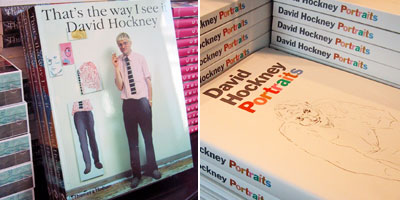
David Hockney fumes over smoking ban


In today's Daily Mail, David Hockney calls for the country's smokers to unite:

'Artist David Hockney says he is "appalled" that the country's 12 million smokers did not stick up for themselves over the smoking ban.

He spoke as the Government announced smoking in enclosed public areas and workplaces will be banned in England from 1 July next year.

Hockney said he will not quit his 50-year habit, adding: "I feel I'm powerless. Pubs aren't health clubs. What do you go to a pub for? "You have an area where people can smoke and an area where people can't smoke. That's what a decent country would do."

FOREST Freedom Organisation for the Right of Enjoy Smoking Tobacco

Sunday, November 26, 2006

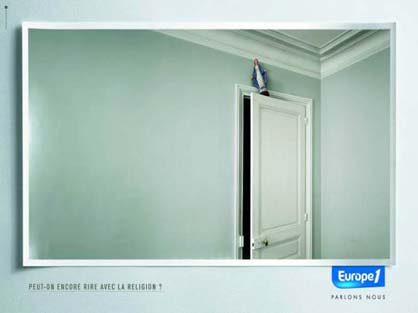
Can we still laugh about religion?


That's the question asked by Europe 1, one of the main French radio stations, for its latest advertising campaign, entitled 'Let's talk to each other' which appears in all main French newspapers and magazines.


Obviously it seems we can still depict the Virgin Mary in awkward positions. One wonders why they didn't choose instead a green crescent or a replica of Mohammad to put above the door. Surely, it would have made good sense and would have attracted them much more publicity.
As it stands, it brings to mind the absurd metropolitan police ad which seemed to suggest that the Bible was at the route of religiously motivated attacks.

See for yourself on Europe 1's website

Wednesday, November 22, 2006

Cause Celebs

An excellent piece in Sunday’s Toronto Star by Dominic Hilton, who nails the phoney bleeding-heart posturings of our beloved celebrity gods…

Seeing the downside of `cause celebs'
At least they're doing something, right? Not necessarily
Nov. 19, 2006.

"As a pop star I have two instincts," Bono once said. "I want to have fun. And I want to change the world."

He also wants his trousers back.

Last Wednesday, Dublin's High Court ruled in favour of Bono against Ms. Lola Cashman, his former stylist. Ms. Cashman was ordered to return a hat, hoop earrings, and a pair of pants she's been hiding in her sock drawer since 1987.

RIP rock `n' roll. After more than 20 years at the pinnacle of the music world, it turns out U2 are playing dress-up. Employing a stylist is akin to hiring your groupies.
And if the Stetson and spurs are props, what are we to make of Bono (a.k.a. Paul Hewson)'s noisy plans to save the world? Did Lola invent those too?

There's an urban legend about Bono that has him playing a concert in Glasgow, when he asks the audience for total quiet. In the silence, he starts to slowly clap his hands, once every few seconds. Holding the audience in total silence, he says into the microphone, "Every time I clap my hands, a child in Africa dies." A Glaswegian voice rings out from near the front of the crowd, piercing the silence... "Well, f---in' stop clappin' then!"

It's not just Bono, who is better informed than most of his ilk and can be praised for working with the Bush government on African issues. Celebs are increasingly desperate to parade the "ethically enlightened" tag. Paris Hilton may look like an airhead, but that's probably because she's concentrating so hard on saving the planet and stuff.

George Clooney does Darfur. Leonardo DiCaprio hugs trees. Courtney Cox has Epidermolysis Bullosa. Geri Halliwell has sex. By their own admission, Tom Hanks, Richard Gere, Ashley Judd, Sharon Stone and others "have" AIDS. Gwyneth Paltrow and David Bowie appear in magazines daubed in tribal paint under the slogan "I am African."

When not boasting a Messianic power to save us all, celebs make believe they live in Angolan mud huts. One can almost hear the stylists pushing these cause celebs. "I see you as an African AIDS victim, darling. I'll make some calls."

When Brad Pitt's not adopting Cambodians or Africans, he's busy building homes in India. Sort of. It's more of a drop-by really, as reported by Reuters:
"Photographs showed Pitt, wearing a white shirt, dark jeans, goggles and a baseball cap, fixing a window grill with gloved hands. Another showed him intently slapping cement on bricks... Pitt spent about half an hour working under the hot sun and talking to volunteers."

Sean Penn took his "personal photographer" with him on his boat to save Katrina victims. The boat sank.

"It's not what you are that counts, but what people think you are," Joseph Kennedy told his sons. It worked for them. Sort of.

USA Today reckons "Being an activist provides a patina of class." If memory serves, a "patina of class" used to involve flogging the flunkies, not dressing up as them. Brangelina ain't Jack and Jackie.

"It's really positive to know that it is a global community," Alicia Keys chimes in, not specifying what her definition of "it" is. "That's why when I speak and I use my voice, I like to emphasize the way that everyday people like you and me can really be a huge hero."

"I'm saving lives," announces mega-heroine Madonna, with typical understatement. Thanks to her controversial adoption of a Malawian "orphan," the Queen of Pop now claims to be a victim of Western race hate. "My children are exposed to all cultures and all races and many belief systems," she brags. And that's just at those British schools.

Not that celebs are renowned for their staying power. "Just staying home and looking after my children and being a mother and a wife is not what I want," Madge said, a mere three weeks after adopting. "I want more. If you want to affect change in the world, you do have to have a platform to stand on." Or a crucifix to be nailed to.

Do-gooder celebs can, of course, have a huge influence on their fans. Kids across America dressed up as Angelina Jolie for Halloween. Long, black hair, black dress, black and white baby dolls in her bag. Spooky.

Not to underplay the idiocy involved. Only this week we've had some new clangers, from Rosie O'Donnell's "Don't fear the terrorists. They're mothers and fathers," to Elton John's "From my point of view I would ban religion completely."

In his utterly botched effort at a comeback, Michael Jackson chose to sing just four lines of the '80s charity hit "We Are The World." A horrifying fit of stage fright did nothing to aid the PR stunt. The sight of Jacko surrounded by pretty kids singing, "We are the children"... well, 'nuff said.

Alright, you might say, but at least these celebs are doing more than you are. But why should musicians and actors "do" anything? And what if their actions are actually doing harm? All the "f---ing money" from Live Aid succeeded only in propping up the Marxist dictatorship that was starving the Ethiopian people and spending all its money on rocket launchers. That can't be worth listening to Bob Geldof try to sing.

Unlike Sir Paul McCartney, many African countries have actually got poorer since the '60s. Why? Well, for starters, because they're locked into a cycle of dependence on Western aid. The last thing Africa needs is more celebrity-encouraged Western guilt. The world's poor are not skint because Brad Pitt is loaded. The West has poured billions into Africa and the result is a continent described by Prime Minister Tony Blair as "a scar on the world's conscience." Most celebs look at this situation and demand... more of the same.

When celebs feel they have a duty to speak out, it is always we (the West) who are blamed for the fact that the world's wretched don't live in Beverly Hills mansions. You never hear a celebrity say, "What Africa really needs is a good dose of regime change." Why don't our rock stars organize a concert demanding African property rights or the scrapping of Africa's protectionist tariffs on agriculture and drugs? And when will we see a business-suited Gwynnie in our magazines highlighting the cancer of African state corruption?

We won't. Celebs consistently get it as wrong as all those '60s economists who predicted North Korea would rapidly outgrow the capitalist South. Things that sound nice do not magically eradicate things that sound horrid. Cancellation of developing world debt can enrich tyrants and penalize responsible governments. Never-ending aid thwarts entrepreneurship and trade development. Even when we Westerners can do something to improve matters, celebrities line up to endorse Farm Aid and Live Aid — regardless of whether the agricultural subsidies of the first help produce the poverty and starvation of the latter. Having not done their homework, and by refusing to accept the indisputable merits of the free markets that stuffed their own wallets, too many celebs are blindly condemning all nations to the fate of Zimbabwe.

In their ignorance, and in great part because we demand it of them, celebs fall headfirst into the pit of guilt-laden Western relativism (though it is worth noting how few celebs actually choose to live in Harare or Pyongyang).

Even Tim Robbins, routinely heralded as the beacon of enlightened celebrity, offered this response when asked by London's Observer to explain his fishy claim that America only launched attacks on Serbian targets because Kosovo threatened U.S. national security: "Ahm... I believe... I'm not the right person to talk about this... but that region of the world, this is the way I've heard it put... Can I go get a cigarette?"

Madonna moans, "If you're a famous person who's trying to make a difference in the world, you'd better be prepared to find yourself in the headquarters of hell." I doubt even Joseph Conrad would have described the Dark Continent so grimly.

Perhaps it has nothing to do with stylists like Lola. Maybe celebs are forced to care only for global issues. After all, their own backyards are way too big.

Sources:The Toronto Star

Dominic Hilton's Blog

Monday, November 20, 2006

It's on 18 Doughty Street, it's on Tuesday, it's... Culture Clash


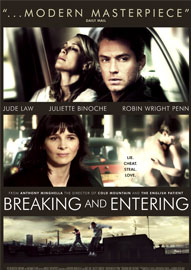
This week on Culture Clash, we’re going to be looking at a film which, if you are to believe the posters, is a ‘modern masterpiece’ – director Anthony Minghella’s Breaking and Entering, an exploration of love and crime in multicultural Kings Cross.

And we’ll be discussing a book which is the hottest political read in the US and Canada – America Alone: The End of the World as We Know it, by the self-styled global content provider, Mark Steyn.

Peter Whittle's guests are Nick Seddon, writer and research fellow at Civitas, Dawn Steeves of The New Criterion magazine, writer Kristin Veblen and Douglas Murray, author of Neoconservatism:Why we need it.

18 Doughty Street

Saturday, November 18, 2006

Eyes Wide Shut


Comments on Minghella's Breaking and Entering

The reason Hollywood will always ultimately triumph over European film is simple: it understands our need to aspire, to dream and to see human life reflected on a larger, more fantastical scale than humdrum reality. Europe on the other hand puts its trust in what it sees as real life. That can be great of course, even if, more often than not, what European movies are actually portraying is a contemporary brand of nihilism which passes for depth.

But European and British films are certainly not averse to the odd fantasy. It’s just that we tend to dress them up in the guise of gritty, searing dramas with something to say about the state-of-the-nation. One such is Breaking and Entering, director Anthony Minghella’s just-released tale about an affluent North London architect (Jude Law) whose security and Sunday supplement life with his cool Swedish wife (Robin Wright Penn) are threatened when he begins an affair with a Bosnian refugee (Juliet Binoche), who’s eking out a living as a seamstress with her delinquent son in sleazy Kings Cross.

The multicultural setting is reminiscent of last year’s Oscar-winner Crash. It all looks very good, in the way that Crash looked good. It’s beautifully shot (but then so are most films these days), and the characters are aesthetically pleasing, even if Law’s vanity, which seems to be increasingly hindering his performances lately, proves to be a real encumbrance here. It’s sort of pleasurable to watch these people glide from scene to scene. But behind the posturing and interior-designed settings, there is actually nothing there at all.

Crash was sold on its supposed fearlessness in telling it like it is on the race issue. It did nothing of the sort of course, basically coming down on the dippy side of Love is all You Need and I’d Like to Teach the World to Sing. Breaking and Entering seems likewise to be claiming to have something to say, but gets around the fact that it hasn’t a clue quite what by indulging in wish-fulfilment and obfuscation. Law’s character gets angry when his firm is repeatedly broken into, but not that angry. He and his wife never exchange so much as a word about the political or social landscape changing around them. Binoche is a beautiful and grateful refugee simply striving to make an honest buck. The cleaner at the firm, also an immigrant, who’s originally suspected of the break-in, quotes Kafka. The grizzled Cockney cop (Ray Winstone) quotes Einstein. Everybody seems to be acting with the best interests of others at heart. And there isn’t a single believable emotion or reaction in the whole two hours.

There’s certainly a market for pictures about people self-absorbed by their lack of fulfilment. But Minghella has set his film firmly in a multicultural milieu which, given the current climate, could only be wilfully ignored, so he must be trying to convey something with it. But he is either too polite or too removed from reality to ask any real questions. What we have instead is a kind of liberal massaging of the situation, with introspection and nuance taking the place of anything which might generate any genuine heat.

Worst of all however, is the avoidance of the real issues which result from sudden mass immigration. Law and his family are rich and privileged, the burglar poor and deprived. It’s a case of have and have-nots, you see. Except in the real world, it isn’t. The affluent can continue to insulate themselves; the real struggles, dislocation and social breakdown happen down there, on the ground. It would be good if somebody made a film about that. But I wouldn’t hold your breath.

PW

Tuesday, November 14, 2006

Moron Four


A much-needed blast at Channel 4 from its founding chief executive Sir Jeremy Isaacs

Writing in Prospect magazine, Isaacs has condemned the channel for moving from the ‘quiet seriousness’ of its early years to ‘an obsession with adolescent transgression and sex.’ It had strayed to far from its public service remit and into the realms of commercialism. Much of the current programming was there purely to attract the lucrative 16-24 year-old youth market.

This has resulted in such shows as Designer Vaginas, The World’s Biggest Penis, and a series of programmes on masturbation called Wank Week. You can read a report about Isaacs’s comments in The Telegraph

Sunday, November 05, 2006

Has Gordon been surfing the Zeitgeist?


The front page of today’s Observer carries a piece about Gordon Brown’s admiration for TV talent shows and the sense of ‘aspiration, how anyone can achieve things’ which they encourage. He talks of wanting to create an ‘X-factor Britain’ :

The story in The Observer


Perhaps he or his advisers read the following piece Peter wrote for the comment pages of The Sunday Telegraph, which appeared only a few weeks ago:


Thursday, November 02, 2006

Time to Read


A very sobering, if not depressing, new publication is George Walden’s Time To Emigrate? Written as a series of letters between a father and a son who is considering leaving Britain for good, it has a truth on every page – the kind of truth which, although often purely based on the anecdotal, still has one nodding one’s head in recognition and agreement.

Walden looks at the future of a country in which mass immigration has permanently altered the landscape, crime is a way of life, civil order is disintegrating and where the population largely has its head in the sand over the magnitude of the threat to its very security. The book however is not shrill or tub-thumping, but is written with humanity and mostly with an air of resignation and sadness.

The cover of the book asks the question Why is nobody talking about what is happening in our country? This must have been written in the full knowledge that millions are, yet have effectively been silenced or disenfranchised. Certainly fear of a creeping anarchy is just beneath the surface – and increasingly not just in the Mail-reading suburbs, but also around the self-styled cosmopolitan dinner tables of North London.

I have however direct experience of what is brought to bear on anybody who is perceived as questioning the official line, one which, certainly in London, is relentlessly pushed to stifle dissent. At one point in his book Walden mentions approvingly an article I wrote in the Sunday Times last year, about the negative changes wrought by immigration and the doctrine of multiculturalism that I’d witnessed in the part of South East London where I grew up. I happened to be standing in the local council elections a few months later, and Labour devoted much time and energy to a vicious personal attack, based on what I’d written, which amounted to libel. Sure enough, they were forced to retract and apologise within a week. But so sure were they that their inference of poisonous racism would close down the debate, they were genuinely taken aback when we didn’t simply slink off to lick our wounds.

The fact that Walden’s book is not considered ‘explosive’ is, however, a sign that the debate has changed and the terms of reference have moved on, in a remarkably short space of time. Even ten years ago, Time to Emigrate? would have been put beyond the pale. But it is still a book which should be read by the increasing numbers who sense that the politically correct platitudes are masking an increasingly disturbing situation.

by Peter Whittle

http://www.gibsonsquare.com
Order Time to Emigrate on Amazon

Tuesday, October 17, 2006

Scary Creatures


One visit to a zoo
May teach you more of man,
Of moral evil and of good,
Than all the sages can.


My apologies to Wordsworth, but I couldn’t help but think of his weird mystical characterization of Man’s relationship with “nature” as I slouched, chastened, from London Zoo on Saturday afternoon.

Zoos have always revealed more about us than about animals. The first public zoos expressed the Victorians’ drive to understand and, above all, master a chaotic world. Confident of Man’s primacy, and determined to conquer ignorance, they collected creatures from every corner of the world, categorized them in a neat taxonomy, and put them on display for the edification of the public.

And that’s a good thing. Like the Victorians, I’ve never seen animals as more than a means to human ends. My personal taxonomy of the Animal Kingdom has just three categories: dangerous, delicious and cuddly. If they can also be educational, that’s a bonus.

None of the preceding, of course, should suggest that it’s OK to inflict senseless cruelty on animals. Quite the opposite: as the only species on this planet with any grasp of right and wrong, and of the meaning of suffering, we have a responsibility to do right by dumb creatures. But it does mean that in any conflict of interest between animals and human beings, I will always root for the latter. People come first.

You would think that a reasonable and indeed a humane proposition – but today’s London Zoo has other ideas. It is on a mission to indoctrinate our children with the message that people are a problem. The problem, in fact.

In August 2005 the Zoo organized a jolly Bank Holiday exercise in misanthropy, exhibiting eight human volunteers in “The Human Zoo”. In a press release, London Zoo explained that the goal of the stunt was to “highlight the spread of man as a plague species and to communicate the importance of man's place in the planet's ecosystem.”

Just think about that phrase: a plague species. All the wonder of humanity – the good and the bad, the striving and the nobility – reduced to the status of a bacillus.

The Human Zoo was not a one off. Many Zoo exhibits have information boards which feature a spectrum of accusation that, and forgive me if I paraphrase, stretches from “under threat by humans” to “about to be wiped out by humans”. Make no mistake, kids. We’re the bad guys. We’re genocidal maniacs.

The children’s petting zoo features a cage which visitors are invited to enter. The sign announces “The Most Dangerous Animal on the Planet”. An accompanying map shows how far this monstrous species has spread itself, multiplying like a virus, across the globe. Humanity as a pandemic: is this really what we want to be teaching the next generation?

Wordsworth’s idea of “nature” as the fountainhead of wisdom and truth, set in opposition to science, was rightly seen by the Victorians as self-indulgent flim-flam. Nice poems – but not much help when it came to building a better world through the exercise of reason.

Sadly, Wordsworth’s silly anti-human ideas appear to be in the ascendant. And not just among the smug middle classes who run and patronize London Zoo.

Human beings, conveniently designated by various regimes as disease agents, are being extinguished around the world as I write. Millions more fall prey to real disease. Lost children, lost parents, shattered families… If there’s any species that could do with a hug, it’s Mankind.

by David S. Taylor

http://www.zsl.org/london-zoo/

Sunday, October 15, 2006

The Screens are Alive with Competition - Peter Whittle in the Sunday Telegraph


Watching television last night, it occurred to me that Simon Cowell should be a national treasure. For those of you who insist on avoiding Saturday night TV and screaming tabloids, Mr Cowell is one of the judges of ITV’s talent show The X Factor. He’s regularly reviled for the supposedly heartless way in which he punctures the illusions of the hundreds of contestants who come before his panel, convinced of the god-given creativity which is going to take them to the top. He weathers the self-pitying tears of tuneless would-be entertainers. Sometimes he is even forced to square up to parents outraged by his dismissal of their off-spring’s unique gifts.

Cowell should be congratulated for his refusal to ingratiate and patronise, but he’s not alone. His is just one of the louder voices to emerge from television’s current love affair with all forms of contest, Whether it’s to be told ‘You’re Fired!’ by Alan Sugar in The Apprentice, or be proclaimed the heir to Julie Andrews by Andrew Lloyd Weber in How Do You Solve a Problem like Maria?, thousands line up in the full glare of millions of viewers to be judged, not by a panel of specialists in empathy training, but by people who’ve made it to the top of their fields, and who’ve presumably earned the right to be listened to.

Of course, these TV contests are predictably condemned for being modish exercises in crass populist sadism, the equivalent of throwing Christians to lions. It can certainly look that way when you witness budding entrepreneurs reduced to wordless terror on Dragon’s Den. But the critics are missing the point.

Television has an odd way of reflecting our concerns and anxieties. After all, what accounts for the popularity of the endless stream of diet and make-over shows, from the worthy Honey, We’re Killing the Kids to the comical Laddette to Lady, if not our fears of creeping social breakdown? No, the fashion for ruthless competition on television represents one of the healthiest trends to emerge in broadcasting for decades – one which shows conclusively that all mustn’t, and shouldn’t, have prizes.

Cowell, Sugar and their fellow judges are providing a desperately needed outlet for our smothered tribal memory that to be the best is a good thing, that a desire to be inspired by the sight of talent rising to the top is perfectly natural. Suppressed for so long in the name of engineering a more ‘fulfilled’ society, it’s seeped out onto the box and hence right back into the centre of our lives.

And we should be grateful: in a time when, according to a report published this week by the think tank Civitas, a full 73% of us can, if we wish, justifiably wallow in official victim status, and when the politically correct promotion of self-esteem takes precedence over any activity which might hurt the feelings of others, such shows can claim to provide the very best in public servicing broadcasting – not in a form that would be immediately obvious to Lord Reith perhaps, but genuine nonetheless.

Perhaps these TV judges should be given control of our state education system. It’s here, after all, that the child-centric ethos of past decades has produced generations of kids who have been told that the necessity for striving, practise and mental self-discipline all come a poor second to their innate, infinite creativity. Anyone who has witnessed a softened-up sports day, or a classroom being encouraged to clap a fellow pupil simply for getting a right answer, realises that children are being sold down the river. It’s not all about feeling good about yourself. So, parents, don’t be afraid – for once, television might actually be setting a good example.